
Feefo
Driving more sales at Feefo with an insights-driven AI prospecting tool


The brief
Feefo holds 70 million purchase-verified reviews across over 5000 brands. Through Syndication, it can distribute product reviews across a global network of major retailers, search engines and partner stores; a review collected through one retail channel builds trust everywhere else that product is sold. This lets a retailer show reviews, even for products it hasn't sold yet, and increases the pool of reviews for everyone using the network. For manufacturers, this helps build trust in their products wherever they’re sold. Ultimately, the whole ecosystem benefits: consumers, manufacturers and retailers alike.
Feefo had an opportunity to onboard more retailers and manufacturers into this network if they could clearly quantify the benefits when first approaching them. To do that, they use a matching process to build a clear picture of how many Feefo reviews applied to that prospect’s product catalogue.
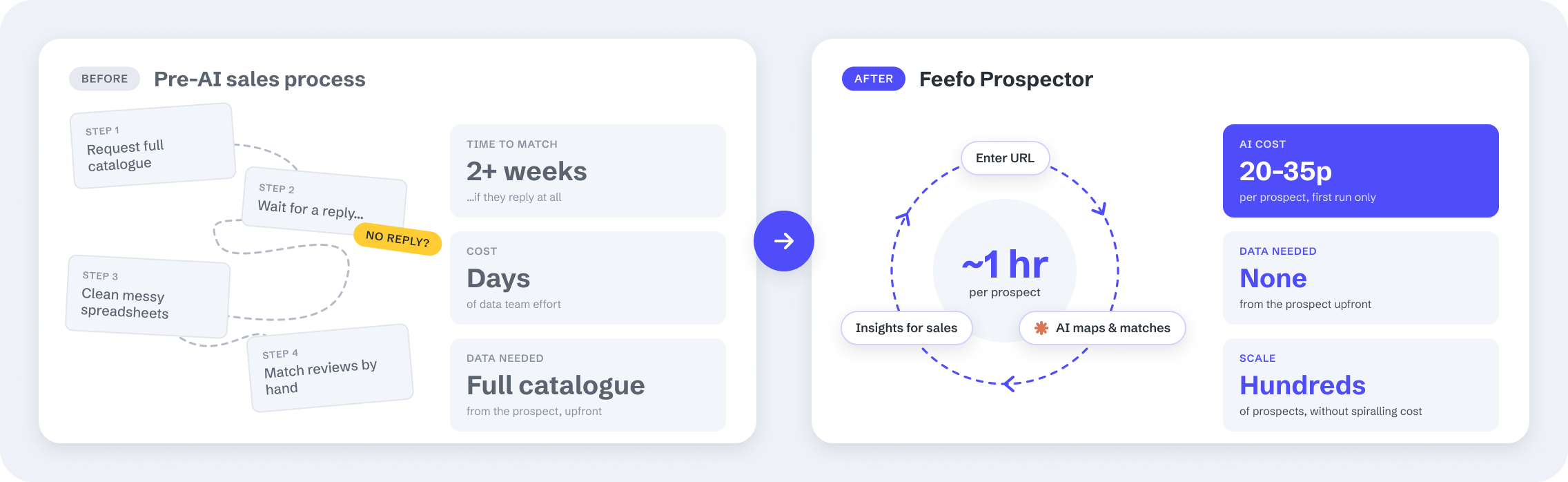
The existing matching process was slow and put the onus on the third party to provide some data upfront. Feefo requests their full product catalogue; once received, the Feefo data team analysed it. The process took over 2 weeks, and that’s if the third party replied at all.
Loomery was brought in to rethink the approach and build an AI-powered solution that combined internal and externally available data sources to quantify matches within minutes rather than weeks, and without needing the third party to share data upfront. This gave the Feefo sales teams the tools and data they needed to target the right organisations and make a compelling pitch from the first outreach.


Project summary
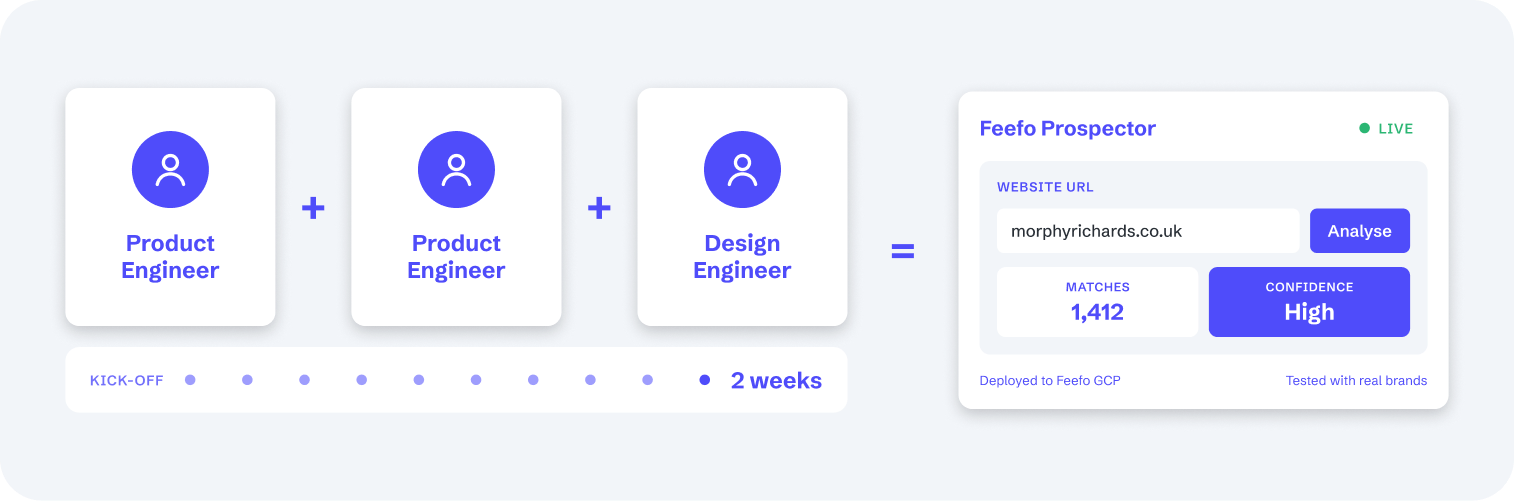
We ran a two-week development cycle with a small cross-functional team: 2 product engineers and a product designer, working alongside Feefo's product, data and commercial teams.
Together we built Feefo Prospector. A salesperson enters a manufacturer or retailer’s website URL, and a Claude-powered agent identifies suitable publicly available sources that represent their product catalogue. It carefully navigates website or API terms and restrictions, making sure they are respected, while creating a ‘recipe’ that describes which sources can be used and how to extract data from them. The application uses the recipe to map the third party’s product catalogue and match every product it finds against Feefo's review data. It uses this to generate analysis, qualified with a confidence score. The analysis includes summary reports, detailed data exports and guidance on the key ways Syndication can add value if the third party joined the network.
Within 2 weeks, we delivered a working product, tested with real brands and refined from real user feedback. We built the containerised app in alignment with Feefo’s technology standards, making it easy to deploy to their managed GCP environment, ready for the sales team to trial further.
The project in numbers
70m
Verified purchase reviews
1 hour
2 weeks down to 1 hour: the time it took to match Feefo’s reviews against a third-party catalogue to assess and quantify the value-add
20–35p
per third party in AI cost, and this applies only when analysis is first run. Recipes and caching ensure repeat runs don’t incur any AI charges
Matching Feefo reviews to products, using public data
The product matches Feefo reviews to the third party’s products with different levels of certainty, depending on the data available. Matching reviews to products using industry-standard unique product identifiers, such as GTINs (Global Trade Item Number), is the most reliable approach. Where product data is published alongside identifiers, our matching confidence level is 100%.
However, plenty of manufacturers and retailers don't publish these. In these cases, we have to look at a broader set of data, including different ‘bridge’ websites that build up a more complete picture of the product catalogue and each product in it. Sometimes casting the net wider surfaced the identifiers eventually; in other cases, we had to fall back to using fields like product descriptions, model, or part numbers as the next best option. When using fallbacks, the confidence score we present alongside the matching analysis is lower.

Spending AI budget once, not every time
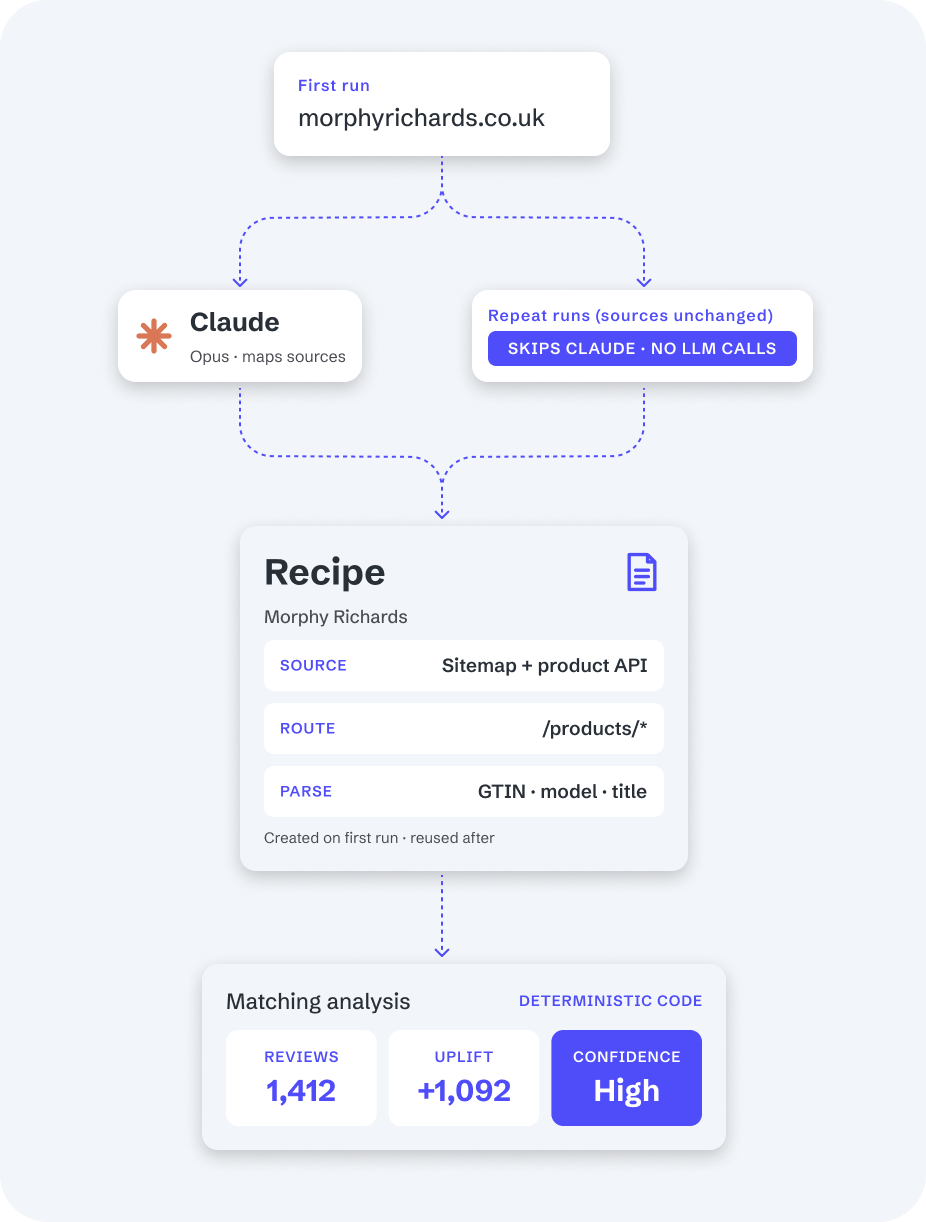
Claude-powered agents brought the most benefit in mapping the best sources of product catalogue data and how to navigate different sites to extract it. This is a step that doesn’t need repeating each time analysis is generated (only if the data source has changed).
Our solution was to use the AI model (Opus) to create a “recipe” the first time we run matching for a brand. This recipe captures the route to the catalogue and how to parse it. Future runs reuse the recipe if the data sources haven’t changed; they can run without any reliance on LLM calls, using deterministic code to gather and analyse the data. This enables Feefo to run this solution for hundreds of prospects without worrying about a spiralling cost of sale.
At Loomery, we always use this principle of combining AI with more conventional deterministic code to ensure each is used where it adds most value.
Conclusion
Feefo already has a trove of 70 million verified reviews - a highly valuable, unique asset. Loomery helps unlock a way to demonstrate the value of this to a universe of prospective customers.
The old sales process had been designed for a pre-AI world, where finding and categorising messy data was complex and costly. By rebuilding the process around what modern AI can do today, we were able to get more value from Feefo’s biggest asset. The result costs pennies per prospect, arrives within minutes or hours rather than weeks, and gives valuable, contextual data and insights to Feefo’s sales team. Feefo are now empowered to win more customers and keep growing their volume of high-quality product reviews so their customers benefit too.
“Our sales team were blown away by the speed at which Loomery understood the challenge and how quickly they were able to deliver.”
— Thora Kehoe, Chief Product Officer, Feefo